Mujhe Chahiye: How to Say What You Want and Need in Hindi
One small word, chahiye, lets you ask for water, order food, turn down a pushy seller and say what you should do. Here's how the pattern works, with every word explained.
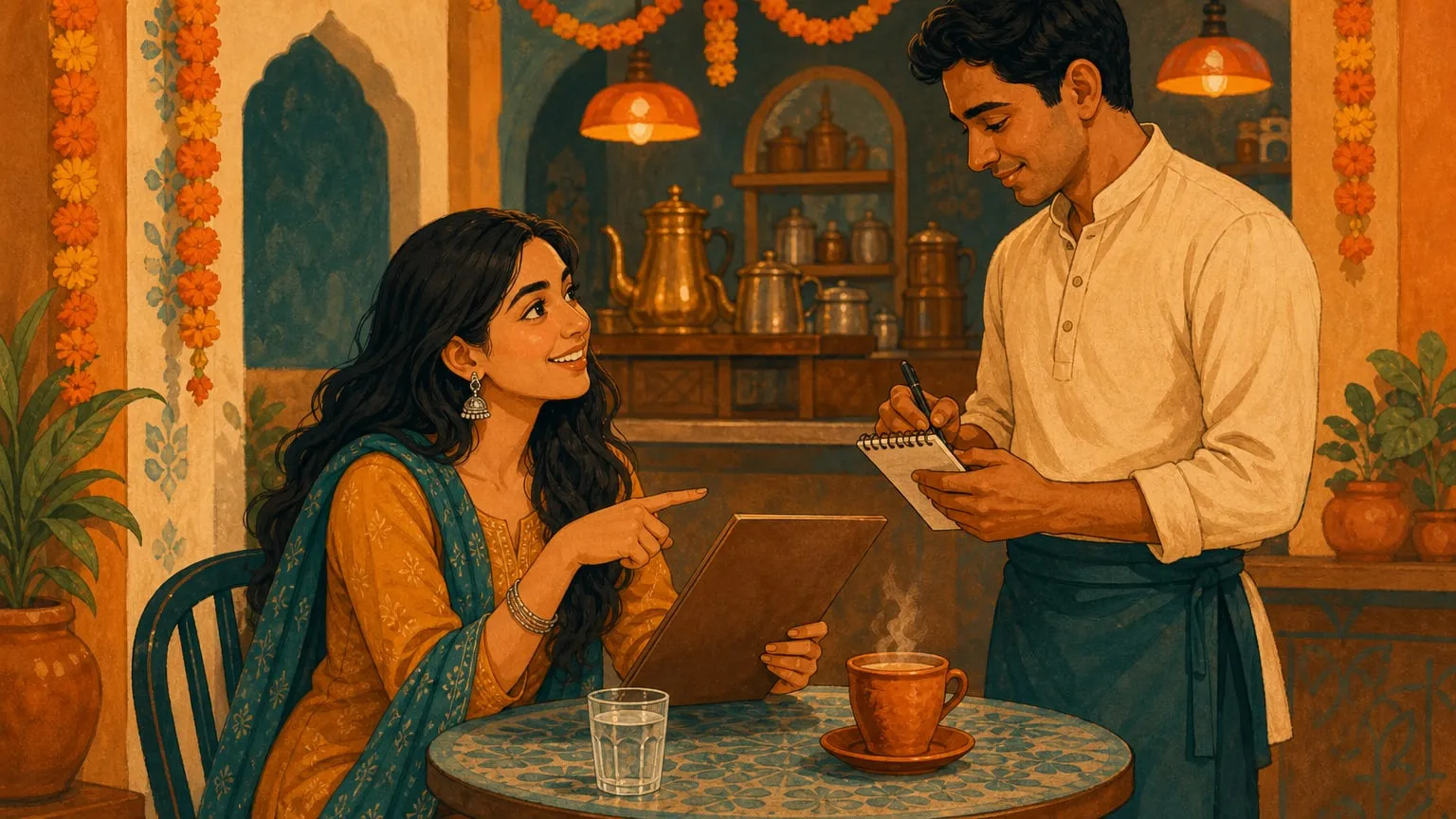
If you could learn only one grammar pattern before a trip to India, chahiye (चाहिए) would be a strong candidate. With it you can ask for water, order at a restaurant, buy a ticket, tell a persistent seller "no thanks" and even say what you ought to do.
It also works a little differently from English, which is exactly why it's worth ten minutes of your time.
The pattern: to me, it is needed
In English, you do the wanting: "I need water". In Hindi, the thing is needed, and it's needed to you:
Mujhe paani chahiye.
मुझे पानी चाहिए।
- Mujhe · to me
- paani · water
- chahiye · is needed
Tip: Word for word: to me, water is needed. The same sentence covers want and need; the context and your tone do the rest.
The shape never changes:
[to whom] + [what] + chahiye
So once you know mujhe (to me), you can ask for anything by dropping a new word into the middle:
- Mujhe chai chahiye. I'd like tea.
- Mujhe menu chahiye. I'd like the menu.
- Mujhe ek ticket chahiye. I need a ticket.
- Mujhe madad chahiye. I need help.
If this "to me" idea feels familiar, it's the same way of thinking as Mujhe thodi Hindi aati hai (a little Hindi comes to me) from our first-week guide. Hindi often describes needing, liking and knowing as something that happens to you.
Changing who needs it
Only the first word changes. These are the forms to learn:
- mujhe (मुझे): to me, I need
- aapko (आपको): to you (respectful), you need
- tumhe (तुम्हें): to you (familiar), you need
- usko or use (उसको / उसे): to him or her, he/she needs
- humein (हमें): to us, we need
- unko or unhein (उनको / उन्हें): to them, they need
Notice that chahiye itself stays the same whoever needs something, and whether that person is a man or a woman. That makes it one of the friendliest words in the language for beginners.
Humein do chai chahiye.
हमें दो चाय चाहिए।
- Humein · to us
- do · two
- chai · tea
- chahiye · is needed
Tip: Nouns like chai don't need a plural ending here. Do chai is simply two teas.
Asking what someone wants
Turn it into a question with kya (what). You'll hear this from every waiter and shopkeeper:
Aapko kya chahiye?
आपको क्या चाहिए?
- Aapko · to you (respectful)
- kya · what
- chahiye · is needed
And when they want to know if that's everything: Aur kuch chahiye? (Anything else?) The easy answer is Bas, "that's all", or Bas, shukriya, "that's all, thanks".
The most useful sentence in a busy market
Add nahin (no, not) and you have a polite, firm way to decline, which you'll use far more often than you expect:
Nahin chahiye, shukriya.
नहीं चाहिए, शुक्रिया।
- Nahin · not
- chahiye · is needed
- shukriya · thank you
Tip: Say it with a smile and keep walking. It works for taxi touts, guides and stallholders alike, and it's much kinder than ignoring someone.
Chahiye for "should"
Put a verb in its dictionary form (the one ending in -na) before chahiye and the meaning shifts from "need" to "should":
Mujhe jaana chahiye.
मुझे जाना चाहिए।
- Mujhe · to me
- jaana · to go
- chahiye · is needed, should
Tip: Literally: to me, going is needed. A polite way to leave: Achchha, mujhe jaana chahiye. (Okay, I should go.)
A few more:
- Aapko aaram karna chahiye. You should rest.
- Humein jaldi jaana chahiye. We should go quickly.
- Mujhe Hindi seekhni chahiye. I should learn Hindi.
In that last one, seekhna (to learn) becomes seekhni because Hindi is a feminine word. Don't let that slow you down: seekhna chahiye would still be understood, and you can polish endings later.
Chahiye or chahta hoon?
There's a related verb, chahna (to want), and learners often mix the two up. The difference is a little like "should" and "want to":
- Mujhe jaana chahiye. I should go. (It's needed.)
- Main jaana chahta hoon. I want to go. (It's my wish.)
With chahna, you are back in charge of the sentence, so it starts with main (I), and the ending follows the speaker: a woman says Main jaana chahti hoon.
Main chai peena chahta hoon.
मैं चाय पीना चाहता हूँ।
- Main · I
- chai · tea
- peena · to drink
- chahta · want
- hoon · am
Tip: A woman says chahti hoon. For simply asking for something, Mujhe chai chahiye is shorter and more natural.
Common mistakes
- "Main paani chahiye." Chahiye needs mujhe, not main: Mujhe paani chahiye.
- Changing chahiye for plurals or for women. In everyday speech it stays chahiye. (You may see chahiyein with plural things in formal writing; you can safely ignore it for now.)
- Worrying that it sounds demanding. Mujhe chai chahiye is perfectly polite in a cafe. When you're asking someone to hand something over, the polite request form is just as natural: Ek chai dijiye. (One tea, please.)
Practice
Try these out loud before you look at the answers:
- I'd like the menu.
- We need two tickets.
- What would you like? (respectful)
- I don't need it, thank you.
- You should rest. (respectful)
- I want to go. (said by a woman)
Answers: Mujhe menu chahiye. · Humein do ticket chahiye. · Aapko kya chahiye? · Nahin chahiye, shukriya. · Aapko aaram karna chahiye. · Main jaana chahti hoon.
One word, and you can already ask, order, decline and give advice in Hindi. Aur kya chahiye? What more do you need?
The EkDoTeen Team
Makers of the EkDoTeen app
We build EkDoTeen to help English speakers say real things in Hindi from their very first day: real phrases, real situations, and every word explained.