Getting Around India in Hindi: Rickshaws, Directions and Markets
Hail a rickshaw, agree a fare, ask the way and bargain at a market, all in simple, polite Hindi. The phrases that matter most once you step outside.
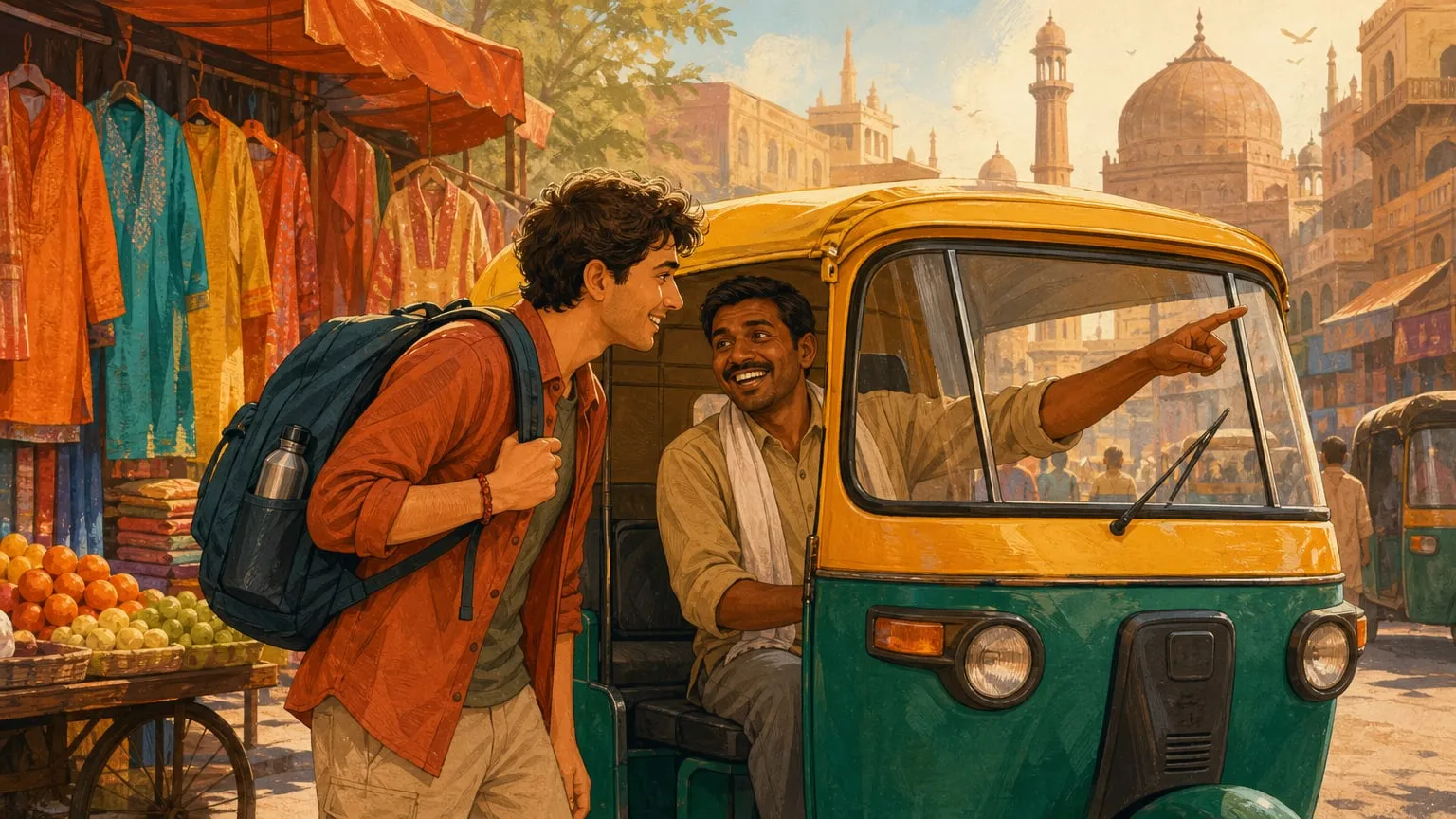
You can get a long way in India with English. But the moment you ask a rickshaw driver a question in Hindi, the conversation changes: a quote gets friendlier, directions get clearer, and a stallholder who was busy with someone else turns round to talk to you.
This guide covers the three situations you'll meet within an hour of stepping outside: taking a rickshaw or taxi, asking for directions and shopping at a market. Every phrase is short, polite and built from words you can reuse everywhere.
Before you start: two words that open every conversation
Bhaiya (भैया) means "brother", and it's how most people get the attention of a driver, a shopkeeper or a waiter who is about their age or older. It is friendly, not overfamiliar. For a woman, didi (दीदी, "older sister") does the same job.
Maaf kijiye (माफ़ कीजिए) means "excuse me" or "sorry". Use it before asking a stranger anything.
Remember the polite -iye ending from our first-week guide? You'll use it constantly here: kijiye, jaaiye, mudiye, chaliye. It turns a plain verb into a polite request.
Taking a rickshaw or taxi
With auto-rickshaws and many taxis, you agree where you're going and what it costs before you get in. The whole exchange usually takes four lines.
1. Ask if they'll go
Say where you want to go, then ask if they'll take you:
Bhaiya, Connaught Place chaloge?
भैया, कनॉट प्लेस चलोगे?
- Bhaiya · brother
- Connaught Place · where you're going
- chaloge · will you go
Tip: Chaloge is the familiar form most people use with drivers. For something more formal, ask: Connaught Place jaayenge?
Swap in any destination: station chaloge?, airport chaloge?, hotel chaloge?
2. Talk about the fare
The driver will usually name a price. Numbers in the hundreds are easy, because sau (सौ) means hundred:
- sau: 100
- dedh sau: 150 (literally "one and a half hundred")
- do sau: 200
- teen sau: 300
- paanch sau: 500
If the price sounds high, say so and offer less: Bahut zyaada hai. Sau mein chalo. (That's too much. Go for a hundred.) If you'd rather use the meter, ask for it:
Meter se chaliye.
मीटर से चलिए।
- Meter se · by the meter
- chaliye · please go
Tip: Se means by, with or from. You'll meet it everywhere: Dilli se (from Delhi), meter se (by the meter).
When you've agreed, close the deal with Achchha, theek hai, chalo. (Okay, fine, let's go.)
3. On the way and arriving
Two questions cover most journeys: Kitna time lagega? (How long will it take?) and, when you're nearly there, a clear request to stop:
Yahan ruk jaaiye.
यहाँ रुक जाइए।
- Yahan · here
- ruk · stop
- jaaiye · please (go ahead and)
Tip: Point as you say it. Aage (further ahead) and thoda aage (a little further) are useful too.
Asking for directions
Start with maaf kijiye, name the place, and add kahan hai? (where is?):
Maaf kijiye, station kahan hai?
माफ़ कीजिए, स्टेशन कहाँ है?
- Maaf kijiye · excuse me
- station · station
- kahan · where
- hai · is
The answer will almost always use a few of these words, so they're worth learning before you need them:
- Seedha jaaiye (सीधा जाइए): go straight
- Daayein mudiye (दाएँ मुड़िए): turn right
- Baayein mudiye (बाएँ मुड़िए): turn left
- Phir (फिर): then
- Yahan / wahan (यहाँ / वहाँ): here / there
- Paas / door (पास / दूर): near / far
A typical reply sounds like Seedha jaaiye, phir daayein mudiye. (Go straight, then turn right.) If you want to know whether to walk, ask Yahan se door hai? (Is it far from here?)
Don't worry if you only catch one word. Repeat back what you understood, "Seedha, phir daayein?", and people will happily confirm or correct you, usually with plenty of pointing.
Shopping and bargaining at a market
In street markets, the first price is rarely the final one. Bargaining is expected, and done with a smile it's a friendly back-and-forth, not a fight. (In shops with printed price tags, it usually isn't.)
Ask the price
Bhaiya, yeh kurta kitne ka hai?
भैया, यह कुर्ता कितने का है?
- Bhaiya · brother
- yeh · this
- kurta · kurta (long shirt)
- kitne ka · of how much
- hai · is
Tip: Leave out the item and point: Yeh kitne ka hai? works for anything.
Ask for a better price
If it's more than you want to pay, say Bahut mehenga hai (बहुत महँगा है, it's very expensive), then ask for a little off:
Thoda kam kijiye.
थोड़ा कम कीजिए।
- Thoda · a little
- kam · less
- kijiye · please do
Tip: This is the phrase sellers expect. Say it warmly, and be ready to meet somewhere in the middle.
A whole market conversation
You: Bhaiya, yeh kurta kitne ka hai? (Brother, how much is this kurta?)
Seller: Yeh paanch sau ka hai. (This is five hundred.)
You: Bahut mehenga hai. Kuch kam kijiye. (It's very expensive. Reduce it a bit.)
Seller: Achchha, teen sau mein de doonga. (Okay, I'll give it for three hundred.)
You: Theek hai, le loonga. (Okay, I'll take it.)
A woman would say le loongi instead of le loonga: the ending follows the speaker, just like peeta and peeti in the first-week guide.
Five tips for using travel Hindi
- Lead with Hindi, even if you switch to English. A namaste and one Hindi sentence set a warm tone for the whole exchange.
- Numbers matter most. If you learn one thing before a trip, make it sau and the numbers one to ten.
- Agree before you go. For rickshaws and market purchases, settle the price first; it avoids awkward moments at the end.
- Politeness beats grammar. Kijiye, shukriya and a smile will carry a sentence with mistakes in it.
- Mix freely. Hindi speakers use English words all the time (station, meter, hotel, final). You can too.
Your practice plan
Say each of these out loud, then try them without looking:
- Ask a driver to take you to the airport.
- Ask them to use the meter.
- Ask a stranger where the market is.
- Understand the reply "Seedha jaaiye, phir baayein mudiye."
- Ask how much something costs, say it's too expensive and ask for a little off.
Answers: Bhaiya, airport chaloge? · Meter se chaliye. · Maaf kijiye, market kahan hai? · go straight, then turn left · Yeh kitne ka hai? Bahut mehenga hai. Thoda kam kijiye.
Shubh yatra! Have a good journey!
The EkDoTeen Team
Makers of the EkDoTeen app
We build EkDoTeen to help English speakers say real things in Hindi from their very first day: real phrases, real situations, and every word explained.