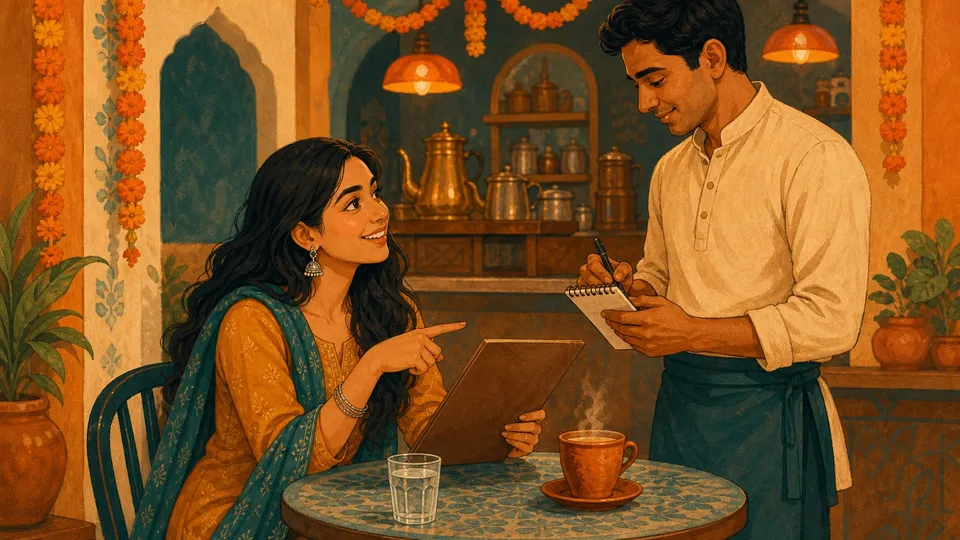
How to Start Speaking Hindi in Your First Week (No Script Required)
You don't need to master Devanagari or memorise grammar tables to say something real in Hindi. Three ideas, twelve phrases and a seven-day plan to get you talking.

Hindi has more than 600 million speakers, and most people who want to join them stall before they start. The script looks like a wall. The grammar books open with gender tables. Somewhere around page twelve, the idea of chatting with a chaiwala in Jaipur quietly slips away.
Here's the good news: you can say real, useful things in Hindi this week, without learning a single letter of Devanagari. This guide gives you the three ideas that make Hindi click, the twelve phrases that do the most work, and a seven-day plan of about ten minutes a day.
Why you can skip the script (for now)
Hindi is written in Devanagari, a beautiful and very logical script, and it is worth learning. But it isn't a gate you have to pass through before you speak. Millions of Hindi speakers type Hindi in Roman letters every day, in text messages, on social media and in film titles, and it works because Roman spelling maps onto Hindi sounds well.
So start with your ears and your mouth, in the alphabet you already read. When the phrases feel familiar, learning the script becomes a pleasure instead of a hurdle.
How to read Roman-script Hindi
A few conventions and you can pronounce almost anything you see:
- a is short, like the a in "about". aa is long, like "father": naam (name).
- i is short, as in "sit". ee is long, as in "see": theek (fine).
- u is short, as in "put". oo is long, as in "food": hoon (am).
- e sounds like the é in "café", and o like the o in "go", without sliding into another vowel.
- An h after a consonant (bh, kh, th, dh, ph) adds a puff of air. th is never the English "th" in "think": it's a t with a breath after it. Many speakers say ph as an f.
- t and d are usually softer than in English, with your tongue touching the back of your top teeth.
Three ideas that make Hindi click
1. The verb comes last
English says "I drink tea". Hindi says "I tea drink am". Once you expect the verb at the end, Hindi sentences stop sounding scrambled and start sounding predictable.
Main chai peeta hoon.
मैं चाय पीता हूँ।
- Main · I
- chai · tea
- peeta · drink
- hoon · am
Tip: A woman says peeti hoon. Verbs change their ending to match who is speaking: -a for a man, -i for a woman.
2. Aap is your safe "you"
Hindi has three words for "you": aap (respectful), tum (familiar) and tu (very close or very rude, depending on how it's used). As a learner, use aap with everyone older than you, with strangers, shopkeepers and drivers. It is always polite and never wrong.
For extra warmth, add -ji after a name or title: Sharma-ji, Mata-ji, Guru-ji. People will notice.
Aap kaise hain?
आप कैसे हैं?
- Aap · you (respectful)
- kaise · how
- hain · are
Tip: Asking a woman? Say Aap kaisi hain? The answer is usually Main theek hoon, shukriya: I'm fine, thank you.
3. Little words come after, not before
English puts "in", "from" and "for" before a word. Hindi puts them after: ghar mein (in the house), Dilli se (from Delhi), mere liye (for me). Flip that one habit and you can talk about where you are, where you're from and what you want.
Main London se hoon.
मैं लंदन से हूँ।
- Main · I
- London se · from London
- hoon · am
Twelve phrases for your first week
These twelve do an enormous amount of work. Say each one out loud. Really out loud: your mouth needs the practice as much as your memory does.
Courtesy and connection
- Namaste (नमस्ते): hello, and goodbye. It literally means "I bow to you".
- Shukriya (शुक्रिया) or dhanyavaad (धन्यवाद): thank you.
- Maaf kijiye (माफ़ कीजिए): excuse me, or sorry.
- Haan / nahin (हाँ / नहीं): yes / no.
- Theek hai (ठीक है): okay, all right. You'll hear it a hundred times a day.
- Phir milenge (फिर मिलेंगे): see you again.
Getting by
- Mera naam … hai (मेरा नाम … है): my name is …
- Mujhe thodi Hindi aati hai (मुझे थोड़ी हिंदी आती है): I know a little Hindi.
- Thoda dheere boliye (थोड़ा धीरे बोलिए): please speak a little more slowly.
- … kahan hai? (… कहाँ है?): where is …?
- Yeh kitne ka hai? (यह कितने का है?): how much is this?
- Ek chai dijiye (एक चाय दीजिए): one tea, please.
Phrase 8 is worth a closer look, because it shows how differently Hindi can think:
Mujhe thodi Hindi aati hai.
मुझे थोड़ी हिंदी आती है।
- Mujhe · to me
- thodi · a little
- Hindi · Hindi
- aati hai · comes
Tip: Word for word: a little Hindi comes to me. Hindi often describes knowing, liking and needing as something that happens to you.
And notice the endings of dijiye, kijiye and boliye. That -iye turns a verb into a polite request. Learn it once and you can politely ask for almost anything.
A seven-day plan, ten minutes a day
- Day 1: Say hello. Namaste, Aap kaise hain?, Main theek hoon, shukriya. Say each one five times, out loud.
- Day 2: Introduce yourself. Mera naam … hai. Main … se hoon. Record yourself on your phone and play it back.
- Day 3: Be polite. Shukriya, maaf kijiye, adding -ji, and the -iye ending: dijiye, kijiye, boliye.
- Day 4: Count to ten. Ek, do, teen, chaar, paanch, chhe, saat, aath, nau, das. Yes, EkDoTeen is "one, two, three".
- Day 5: Ask questions. Kahan? (where?), kitna? (how much?), kya? (what?). Point at things around your home and ask Yeh kya hai? (what is this?).
- Day 6: Have a whole conversation. Act out the chai-stall scene below, playing both parts.
- Day 7: Use it for real. Greet someone who speaks Hindi, send a message in Roman-script Hindi, or order in Hindi at an Indian restaurant. Expect a smile.
Your first conversation: at the chai stall
You: Bhaiya, ek chai dijiye. (Brother, one tea, please.)
Chaiwala: Haan ji. Cheeni kitni? (Sure. How much sugar?)
You: Thodi si. Adrak bhi daaliye. (Just a little. Add ginger too.)
Chaiwala: Theek hai. Das rupaye. (Okay. Ten rupees.)
You: Yeh lijiye. Shukriya! (Here you go. Thank you!)
Five short lines, and you've greeted someone respectfully, ordered, answered a question, handled money and said thank you. That is a real exchange.
First-week mistakes (and why they don't matter much)
- Saying tum to a stranger. Switch to aap; nobody will mind the slip.
- Putting the verb in the middle. You'll still be understood. Move it to the end next time.
- Mixing up masculine and feminine endings. Everyone does at first, and it rarely gets in the way of meaning.
- Waiting until you feel ready. This is the only one that really costs you. Hindi speakers are famously delighted when someone makes the effort, so a friendly namaste and a halting sentence will get you further than a perfect one you never say.
Where to go from here
After a week you'll have greetings, introductions, politeness, numbers, questions and a whole conversation. Next, build on it with more real situations: asking for directions, bargaining at a market, catching a rickshaw. Keep the habit small and daily. Ten minutes every day beats an hour on Sunday.
Ek, do, teen… bolo! One, two, three… speak!
The EkDoTeen Team
Makers of the EkDoTeen app
We build EkDoTeen to help English speakers say real things in Hindi from their very first day: real phrases, real situations, and every word explained.